Armenia: history in brief
One of the world's oldest Christian nations, with its own alphabet since the 5th century and a capital older than Rome.
Test yourself
Which came first?
History in brief
Ancient world In 782 BC King Argishti I of Urartu founded Erebuni, the future Yerevan. Tigranes the Great stretched Armenia from the Caspian to the Mediterranean; in 301 it became the first state to adopt Christianity, and in 405 Mesrop Mashtots created the alphabet.
Middle Ages In the 10th–11th centuries the Bagratid capital was Ani, the “city of 1,001 churches”. Grigor Narekatsi wrote his Book of Lamentations, and from 1198 to 1375 the Armenian Kingdom of Cilicia thrived on the Mediterranean, trading with Venice and Genoa.
Early modern & modern era In 1512 the first printed Armenian book appeared in Venice, and since 1717 the Mekhitarist monks have worked on the island of San Lazzaro. In 1828 Eastern Armenia became part of the Russian Empire; Abovian and Tumanyan shaped modern Armenian literature.
Contemporary era In 1915 the Armenian people suffered the Genocide, in which about 1.5 million died. In 1918, after the victory at Sardarapat, the First Republic was born, and on 21 September 1991 Armenia became independent. Its team has won the Chess Olympiad three times.
Interesting facts
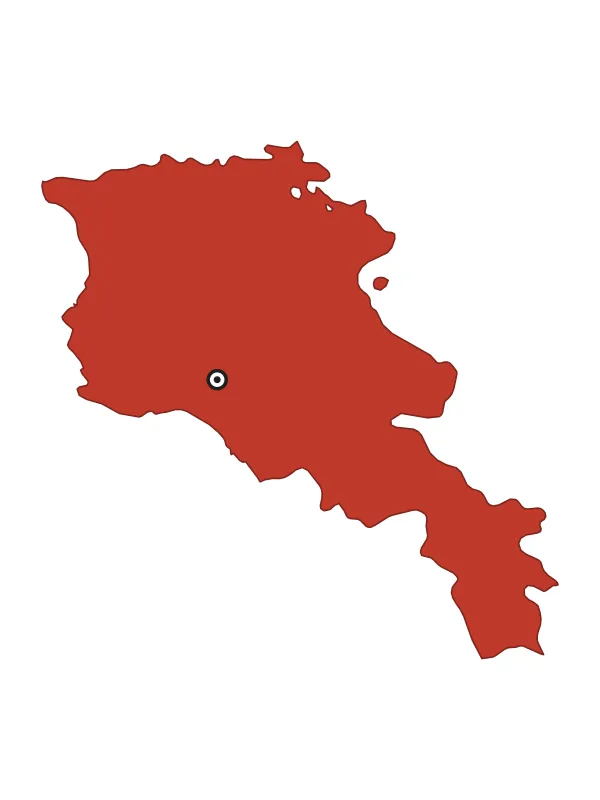
- Mesrop Mashtots's alphabet of 405 had 36 letters; two more were added later, and it is still used today.
- Etchmiadzin Cathedral was founded in the early 4th century, making it one of the oldest cathedrals in the world.
- Areni-1 cave held the oldest known winery (about 6,100 years old) and a 5,500-year-old leather shoe.
- Armenia won the Chess Olympiad in 2006, 2008 and 2012, and since 2011 chess has been a school subject.
- Yerevan's Matenadaran keeps about 20,000 old manuscripts, one of the richest collections in the world.
Key moments
- 782 BCFortress of Erebuni foundedThe Urartian king Argishti I founded the fortress where Yerevan stands today, as a cuneiform inscription records.
- 95 BCTigranes the Great becomes king of ArmeniaUnder him Armenia became one of the strongest powers in the Middle East, stretching "from sea to sea".
- 77Construction of the Garni TempleThe pagan temple of Garni was built under King Tiridates I; it is the only colonnaded temple of antiquity standing in Armenia.
- 301Armenia adopts Christianity as state religionBy tradition, King Tiridates III and Gregory the Illuminator made Armenia the first country with Christianity as its state religion.
- 303Completion of Etchmiadzin CathedralEtchmiadzin Cathedral was completed in Vagharshapat; it is one of the oldest Christian cathedrals in the world.
- 405Mesrop Mashtots creates the Armenian alphabetThe first sentence written in the new letters came from the Book of Proverbs: "To know wisdom and instruction".
All dates (150)
Ancient world
- 782 BCFortress of Erebuni foundedThe Urartian king Argishti I founded the fortress where Yerevan stands today, as a cuneiform inscription records.
- 776 BCFounding of ArgishtikhiniliArgishti I founded the city of Argishtikhinili in the Ararat Valley, one of the largest cities of Urartu.
- 331 BCIndependence of Armenia under the OrontidsAfter Alexander the Great defeated Persia at Gaugamela, the Orontid (Yervanduni) dynasty ruled Armenia as independent kings.
- 189 BCArtaxias I becomes kingArtaxias I proclaimed himself king of Greater Armenia and founded the Artaxiad dynasty.
- 176 BCFounding of ArtashatKing Artaxias I founded a new Armenian capital on the Araxes; legend says Hannibal helped choose the site.
- 95 BCTigranes the Great becomes king of ArmeniaUnder him Armenia became one of the strongest powers in the Middle East, stretching "from sea to sea".
- 83 BCTigranes the Great takes the Syrian throneThe Syrians invited Tigranes to the Seleucid throne, and Armenia reached the Mediterranean Sea.
- 69 BCBattle of TigranocertaThe Roman general Lucullus defeated the army of Tigranes outside his new capital, Tigranocerta.
- 66 BCPeace of Artaxata with PompeyTigranes the Great made peace with Pompey near Artaxata and kept Greater Armenia.
- 53 BCTheatre of Artavasdes II at ArtaxataEuripides' Bacchae was staged at Artaxata under King Artavasdes II, the earliest known performance in an Armenian theatre.
- 63Peace of RhandeiaRome and Parthia agreed that Tiridates I would rule Armenia but receive his crown from the Roman emperor.
- 66Tiridates I crowned in RomeEmperor Nero crowned Tiridates I in Rome, securing the Arsacid (Arshakuni) dynasty on the Armenian throne.
- 77Construction of the Garni TempleThe pagan temple of Garni was built under King Tiridates I; it is the only colonnaded temple of antiquity standing in Armenia.
- 114Trajan makes Armenia a Roman provinceEmperor Trajan turned Armenia into a Roman province, but Rome gave it up only three years later.
- 301Armenia adopts Christianity as state religionBy tradition, King Tiridates III and Gregory the Illuminator made Armenia the first country with Christianity as its state religion.
- 303Completion of Etchmiadzin CathedralEtchmiadzin Cathedral was completed in Vagharshapat; it is one of the oldest Christian cathedrals in the world.
- 371Battle of DziravThe Armenian army under King Pap and commander Mushegh Mamikonian defeated the Persians on the plain of Dzirav.
- 387Partition of Armenia between Rome and PersiaRome and Sasanian Persia divided Greater Armenia, with most of the country going to Persia.
- 405Mesrop Mashtots creates the Armenian alphabetThe first sentence written in the new letters came from the Book of Proverbs: "To know wisdom and instruction".
- 428End of the Arsacid kingdom of ArmeniaThe Persian king deposed Artashes IV, the last Arsacid king, and the Armenian monarchy was abolished.
- 440Death of Mesrop MashtotsThe creator of the Armenian alphabet was buried in Oshakan, where a church now stands over his grave.
- 451Battle of AvarayrArmenians led by Vardan Mamikonian fought the Persian army in defence of their Christian faith.
Middle Ages
- 484Treaty of NvarsakAfter the uprising led by Vahan Mamikonian, Persia recognised the Armenians' freedom of religion.
- 552Start of the Armenian calendar eraThe Armenian era begins in this year; it was used to date manuscripts and inscriptions for centuries.
- 618Building of St Hripsime ChurchCatholicos Komitas built St Hripsime Church in Vagharshapat, a masterpiece of early medieval Armenian architecture.
- 630Building of St Gayane ChurchSt Gayane Church was built in Vagharshapat by order of Catholicos Ezr.
- 643Construction of Zvartnots beginsCatholicos Nerses III the Builder began the round cathedral of Zvartnots, whose ruins are now a UNESCO site.
- 775Battle of BagrevandAn uprising of Armenian princes against the Arab Caliphate ended in defeat at the Battle of Bagrevand.
- 874Founding of SevanavankPrincess Mariam, daughter of Ashot Bagratuni, founded a monastery on an island (now a peninsula) in Lake Sevan.
- 885Coronation of Ashot I BagratuniAshot I was recognised as king of Armenia, restoring the Armenian kingdom under the Bagratid dynasty.
- 895Church of Sts Peter and Paul at Tatev foundedThe main church of Tatev Monastery, dedicated to Saints Peter and Paul, was founded; it was completed in 906.
- 908Founding of the Kingdom of VaspurakanPrince Gagik Artsruni became king of Vaspurakan, an Armenian kingdom around Lake Van.
- 915Holy Cross Church on Akhtamar begunArchitect Manuel began the Church of the Holy Cross on Akhtamar Island in Lake Van for King Gagik Artsruni.
- 961Ani becomes the capital of ArmeniaKing Ashot III the Merciful moved the capital to Ani, later called the 'city of 1001 churches'.
- 976Founding of Haghpat MonasteryKing Ashot III and Queen Khosrovanuysh founded Haghpat Monastery in Lori, now a UNESCO World Heritage site.
- 1001Cathedral of Ani completedBuilt by the architect Trdat in the capital of Armenia's Bagratid kings, it is a masterpiece of medieval architecture.
- 1002Gregory of Narek's Book of LamentationsGregory of Narek completed his Book of Lamentations, a prayer-poem and a peak of medieval Armenian poetry.
- 1033Building of St Gregory Church at KecharisPrince Grigor Pahlavuni (Magistros) built the first church of Kecharis Monastery in Tsaghkadzor.
- 1035Church of the Holy Saviour in AniPrince Ablgharib Pahlavuni built the Church of the Holy Saviour in Ani to house a relic of the True Cross from Constantinople.
- 1045Fall of the Bagratid kingdom of AniAni passed to the Byzantine Empire, and the Bagratid kingdom of Armenia came to an end.
- 1064Seljuk capture of AniThe army of the Seljuk sultan Alp Arslan captured and sacked Ani.
- 1080Founding of the Armenian principality of CiliciaPrince Ruben founded an Armenian principality in the mountains of Cilicia, which later became a kingdom.
- 1166Nerses Shnorhali becomes CatholicosThe poet, hymn writer and theologian Nerses Shnorhali ('the Gracious') became head of the Armenian Church.
- 1184Mkhitar Heratsi's Consolation of FeversPhysician Mkhitar Heratsi wrote the Consolation of Fevers, the key work of medieval Armenian medicine.
- 1188Founding of Goshavank MonasteryThe scholar and lawmaker Mkhitar Gosh founded the monastery later named Goshavank in his honour.
- 1198Coronation of Levon I in CiliciaPrince Levon received a royal crown, and Armenian Cilicia became a kingdom.
- 1199The Zakarids free AniArmenian generals Zakare and Ivane Zakarian, allied with the Kingdom of Georgia, freed Ani.
- 1215Main church of Geghard builtThe main church, Katoghike, was built at Geghard, a monastery partly carved into the rock.
- 1236Mongol capture of AniA Mongol army captured Ani, and the city began its slow decline.
- 1254King Hetum I travels to KarakorumHetum I, king of Cilician Armenia, travelled to the Mongol khan in Karakorum and made an alliance with him.
- 1256Toros Roslin's Zeytun GospelsMiniaturist Toros Roslin created the Zeytun Gospels, the earliest of his signed manuscripts.
- 1265Law code of Smbat SparapetCommander and jurist Smbat Sparapet, brother of King Hetum I, compiled the law code of Cilician Armenia.
- 1332Building of the Selim CaravanseraiPrince Chesar Orbelian built a caravanserai on the Selim Pass for travellers on the Silk Road.
- 1339Church of the Holy Mother of God at NoravankThe two-storey Church of the Holy Mother of God (Burtelashen) was completed; its design is attributed to master Momik.
- 1375Fall of the Armenian Kingdom of CiliciaThe Mamluks captured the capital, Sis, and took the last king, Levon, prisoner.
- 1393Death of Levon V in ParisThe last king of Cilician Armenia died in exile in Paris; his tomb is now in the Basilica of Saint-Denis.
- 1441The Catholicosate returns to EtchmiadzinA church council made Etchmiadzin the seat of the Catholicos of All Armenians once again.
Early modern & modern era
- 1512First printed Armenian bookHakob Meghapart printed the Urbatagirk ('Friday Book') in Venice, the first printed book in Armenian.
- 1565Abgar Tokhatetsi's press in VeniceAbgar Tokhatetsi printed an Armenian calendar and a Psalter in Venice, continuing Hakob Meghapart's work.
- 1605Founding of New JulfaArmenians resettled by Shah Abbas I founded New Julfa in Isfahan, which became a hub of Armenian trade.
- 1666First printed Armenian BibleVoskan Yerevantsi printed the first complete Armenian Bible in Amsterdam.
- 1695First printed world map in ArmenianThe Armenian press of the Vanandetsi family in Amsterdam published a large world map in Armenian.
- 1717Mekhitarists settle on San LazzaroMkhitar Sebastatsi and his monks settled on the island of San Lazzaro in Venice, later a centre of Armenian studies.
- 1722David Bek's uprising beginsDavid Bek led the liberation struggle of the Armenians of Syunik.
- 1771First printing press in ArmeniaCatholicos Simeon Yerevantsi opened the first printing press in Armenia itself, at Etchmiadzin.
- 1794Azdarar, the first Armenian periodicalPriest Harutyun Shmavonian began publishing Azdarar in Madras, the first Armenian periodical.
- 1815Founding of the Lazarev InstituteThe Lazarev family founded an Armenian school in Moscow that became a centre of Oriental studies.
- 1824Founding of the Nersisian SchoolArchbishop Nerses Ashtaraketsi founded a school in Tiflis where many Armenian writers and public figures studied.
- 1827Capture of the Erivan FortressDuring the Russo-Persian War, Russian troops took the Erivan Fortress.
- 1828Creation of the Armenian OblastAfter the Treaty of Turkmenchay, Russia formed the Armenian Oblast on newly annexed lands of Eastern Armenia.
- 1829First ascent of Mount AraratFriedrich Parrot and Khachatur Abovian made the first recorded ascent to the summit of Mount Ararat.
- 1841Abovian writes Wounds of ArmeniaKhachatur Abovian wrote Wounds of Armenia, the first novel in modern Armenian.
- 1850Aivazovsky's The Ninth WaveIvan (Hovhannes) Aivazovsky painted The Ninth Wave, one of the world's best-known seascapes.
- 1863Armenian National ConstitutionThe Ottoman government approved a charter letting Armenians run their own church, school and community affairs.
- 1868Arshak II, the first Armenian operaTigran Chukhajian completed Arshak II in Constantinople, the first Armenian opera.
- 1871Premiere of Sundukian's PepoGabriel Sundukian's comedy Pepo, about a poor fisherman, was first staged in Tiflis.
- 1872Founding of the newspaper MshakGrigor Artsruni launched Mshak in Tiflis, one of the most influential Armenian newspapers.
- 1873Epic 'Daredevils of Sassoun' first recordedGaregin Srvandztiants first wrote down the Armenian epic of David of Sassoun from a folk storyteller.
- 1874Opening of the Gevorgian SeminaryThe Gevorgian Seminary opened at Etchmiadzin; Komitas and many Armenian scholars studied there.
- 1880Raffi's novel The FoolThe Tiflis newspaper Mshak began serialising Raffi's novel The Fool (Khent).
- 1887First brandy factory in YerevanMerchant Nerses Tairiants opened a brandy factory in Yerevan, later bought by the Shustov company.
- 1892Excavations at Ani beginOrientalist Nicholas Marr began systematic excavations of the medieval Armenian capital of Ani.
- 1892Publication of the poem AnoushHovhannes Tumanyan's poem Anoush, a love story set in the mountains of Lori, first appeared in his collection in Moscow.
- 1899The Vernatun literary circleThe Vernatun circle began meeting at Tumanyan's flat in Tiflis, with Aghayan, Isahakian, Shant and others.
- 1906Komitas performs in ParisKomitas introduced Armenian folk and sacred music to Paris audiences, earning high praise from critics.
- 1908Teryan's collection Twilight DreamsVahan Teryan's first collection, Twilight Dreams, came out in Tiflis and made him famous at once.
- 1909Isahakian's poem Abu Lala MahariAvetik Isahakian wrote Abu Lala Mahari, a poem about an Arab poet who leaves society for the desert.
- 1912Premiere of the opera AnoushArmen Tigranian's opera Anoush, based on Tumanyan's poem, premiered in Alexandropol (now Gyumri).
Contemporary era
- 1915The Armenian GenocideThe Ottoman Empire carried out the mass killing and deportation of Armenians; 24 April is the day of remembrance.
- 1918Battle of SardarabadArmenian troops and volunteers halted the Ottoman army's advance at Sardarabad.
- 1918Proclamation of the First Republic of ArmeniaOn 28 May the independent Republic of Armenia was proclaimed, the first Armenian state in centuries.
- 1919Founding of Yerevan State UniversityArmenia's first university was founded; today it is Yerevan State University.
- 1921Founding of the National Gallery of ArmeniaAn art museum was founded in Yerevan that grew into the National Gallery, the country's largest art collection.
- 1922First State Theatre of Armenia opensThe First State Theatre opened in Yerevan; today it is the Sundukyan National Academic Theatre.
- 1924Tamanian's master plan for YerevanArchitect Alexander Tamanian's master plan for Yerevan was approved and shaped the city for decades.
- 1926Namus, the first Armenian feature filmHamo Beknazarian's film Namus, based on Alexander Shirvanzade's play, was released.
- 1930Premiere of the opera AlmastAlexander Spendiarian's opera Almast was first performed in Moscow.
- 1933Yerevan Opera and Ballet Theatre opensThe Yerevan Opera and Ballet Theatre gave its first performance, Spendiarian's opera Almast.
- 1935Pepo, the first Armenian sound filmHamo Beknazarian filmed Sundukian's play, and Armenian speech was heard on screen for the first time.
- 1939Excavations at Karmir Blur beginBoris Piotrovsky began excavating the Urartian fortress of Teishebaini on Karmir Blur hill in Yerevan.
- 1942Premiere of Khachaturian's ballet GayaneAram Khachaturian's “Sabre Dance” was first heard at the Kirov Theatre's premiere of the ballet in Perm.
- 1943Founding of the Armenian Academy of SciencesThe Academy of Sciences was founded in Yerevan; astrophysicist Viktor Ambartsumian was among its founders.
- 1946Founding of Byurakan ObservatoryAstrophysicist Viktor Ambartsumian founded the observatory on the slopes of Mount Aragats.
- 1947Discovery of stellar associationsViktor Ambartsumian discovered stellar associations, showing that stars are still being born today.
- 1950Erebuni foundation inscription foundA cuneiform inscription of Argishti I was found on Arin Berd hill, proving that the Erebuni fortress stood there.
- 1952Hrant Shahinyan's Olympic goldIn Helsinki gymnast Hrant Shahinyan won gold on the rings and in the team event, becoming the first Olympic champion from Armenia.
- 1956Yerevan Institute of Mathematical Machines foundedMathematician Sergey Mergelyan was its first director, and the institute built the Razdan and Nairi computers.
- 1956Premiere of the ballet SpartacusAram Khachaturian's ballet Spartacus premiered in Leningrad.
- 1959Statue of David of SassounYervand Kochar's equestrian statue of the epic hero David of Sassoun was unveiled outside Yerevan railway station.
- 1959Matenadaran becomes a research instituteThe Matenadaran repository of ancient manuscripts became a research institute in a new building in central Yerevan.
- 1959Sevak's poem The Unsilenceable BelfryParuyr Sevak published The Unsilenceable Belfry, a poem dedicated to Komitas.
- 1961Ambartsumian heads the International Astronomical UnionViktor Ambartsumian was elected President of the International Astronomical Union.
- 1963Tigran Petrosian becomes world chess championIn a match in Moscow, Petrosian defeated Mikhail Botvinnik to become the ninth world champion.
- 1967Mother Armenia monumentSculptor Ara Harutyunyan's statue Mother Armenia was erected in Yerevan's Victory Park.
- 1967Saryan House-Museum foundedA museum was founded in painter Martiros Saryan's Yerevan home while he was still alive.
- 1968Erebuni Museum opensFor Yerevan's 2,750th anniversary, a museum opened at the foot of the Erebuni fortress.
- 1968Sardarabad Memorial opensThe memorial by architect Rafael Israelyan opened for the 50th anniversary of the Battle of Sardarabad.
- 1969Parajanov's The Color of PomegranatesSergei Parajanov's poetic film about the life of the poet-singer Sayat-Nova, shot in Armenia, premiered in Yerevan.
- 1973Ararat Yerevan wins the Soviet doubleFC Ararat Yerevan won both the Soviet football championship and the Soviet Cup in a single season.
- 1974First volume of the Armenian Soviet EncyclopediaThe first of the 12 volumes of the Armenian Soviet Encyclopedia was published.
- 1975Restoration of the Garni TempleThe Garni Temple, destroyed in the 1679 earthquake, was rebuilt largely from its original stones.
- 1980Yurik Vardanyan's Olympic goldWeightlifter Yurik Vardanyan won Olympic gold in Moscow with a world record.
- 1981Yerevan Metro opensThe first section of the Yerevan Metro opened with four stations.
- 1990Armenian Declaration of IndependenceArmenia's Supreme Council adopted the Declaration of Independence, starting the path to statehood.
- 1991Armenian independence referendumOn 21 September Armenians voted for independence; the date is now Independence Day.
- 1991Mer Hayrenik becomes the national anthemThe song Mer Hayrenik ('Our Fatherland'), with words by Mikael Nalbandian, became Armenia's national anthem.
- 1991Sergei Parajanov Museum opensA house-museum of the film director and artist Sergei Parajanov opened in Yerevan.
- 1992Armenia joins the United NationsThe Republic of Armenia became a member of the United Nations.
- 1992Armenia's first national football matchArmenia's national team played its first match, against Moldova in Yerevan (0–0).
- 1993Introduction of the Armenian dramArmenia introduced its own national currency, the dram.
- 1995Adoption of the Constitution of ArmeniaVoters adopted the first Constitution of independent Armenia in a referendum; 5 July is Constitution Day.
- 1996Haghpat becomes Armenia's first UNESCO siteHaghpat Monastery became Armenia's first World Heritage Site; Sanahin was added to it in 2000.
- 1996Independent Armenia's first Olympic goldWrestler Armen Nazaryan won at the Atlanta Olympics, independent Armenia's first gold medal.
- 2000Etchmiadzin, Zvartnots and Geghard join UNESCO listThe churches of Etchmiadzin, the ruins of Zvartnots and Geghard Monastery were added to the World Heritage List.
- 2001Consecration of St Gregory the Illuminator CathedralTo mark 1,700 years of Christianity in Armenia, the largest Armenian cathedral was consecrated in Yerevan.
- 2005Armenian Alphabet MonumentFor 1,600 years of Armenian writing, giant stone letters of the alphabet were set up near the village of Artashavan.
- 2005Armenian duduk recognised by UNESCOUNESCO proclaimed Armenian duduk music a Masterpiece of the Oral and Intangible Heritage of Humanity.
- 2006Armenia wins the Chess OlympiadIn Turin, Armenia's men's team won the Olympiad for the first time, then repeated it in 2008 and 2012.
- 2006Armenia's Eurovision debutArmenia made its Eurovision debut in Athens with André singing “Without Your Love”.
- 2008Armenia's second Chess Olympiad winIn Dresden, Armenia won the World Chess Olympiad for the second time in a row.
- 2009Cafesjian Center for the Arts opensA museum of contemporary art founded by philanthropist Gerard Cafesjian opened in Yerevan's Cascade.
- 2010World's oldest leather shoe from Areni-1Scientists announced a leather shoe about 5,500 years old from Areni-1 cave, the oldest known in the world.
- 2010Armenia wins Junior EurovisionVladimir Arzumanyan won Junior Eurovision in Minsk with the song “Mama”, Armenia's first victory there.
- 2010Khachkar art on UNESCO's listThe art of Armenian khachkars, carved cross-stones, was inscribed on UNESCO's Intangible Heritage list.
- 2010Wings of Tatev cable car opensA 5.7 km cable car to Tatev Monastery opened and entered the Guinness World Records.
- 2011Chess becomes a compulsory school subjectArmenia became the first country to make chess a compulsory subject in primary schools.
- 2011Armenia wins the World Team Chess ChampionshipIn Ningbo, China, Armenia won the World Team Chess Championship.
- 2012Armenia's third Chess Olympiad winIn Istanbul, Armenia won the World Chess Olympiad for the third time.
- 2014Lavash on UNESCO's listThe tradition of making Armenian lavash bread was inscribed on UNESCO's Intangible Heritage list.
- 2015Komitas Museum-Institute opensA museum-institute opened in Yerevan for Komitas, the composer who collected thousands of Armenian folk songs.
5 questions of the day Where was it? Timeline
Eras
- Ancient worldbefore 476 · 178 events
- Middle Ages476–1491 · 206 events
- Early modern & modern era1492–1913 · 251 events
- Contemporary era1914 onwards · 217 events
History of countries
 Afghanistan
 Albania
 Algeria
 Andorra
 Angola
 Antigua and Barbuda
 Argentina
 Armenia
 Australia
 Austria
 Azerbaijan
 Bahamas
 Bahrain
 Bangladesh
 Barbados
 Belarus
 Belgium
 Belize
 Benin
 Bhutan
 Bolivia
 Bosnia and Herzegovina
 Botswana
 Brazil
 Brunei
 Bulgaria
 Burkina Faso
 Burundi
 Cambodia
 Cameroon
 Canada
 Cape Verde
 Central African Republic
 Chad
 Chile
 China
 Colombia
 Comoros
 Costa Rica
 Croatia
 Cuba
 Cyprus
 Czechia
 Denmark
 Djibouti
 Dominica
 Dominican Republic
 DR Congo
 East Timor
 Ecuador
 Egypt
 El Salvador
 Equatorial Guinea
 Eritrea
 Estonia
 Eswatini
 Ethiopia
 Fiji
 Finland
 France
 Gabon
 Gambia
 Georgia
 Germany
 Ghana
 Greece
 Grenada
 Guatemala
 Guinea
 Guinea-Bissau
 Guyana
 Haiti
 Honduras
 Hungary
 Iceland
 India
 Indonesia
 Iran
 Iraq
 Ireland
 Israel
 Italy
 Ivory Coast
 Jamaica
 Japan
 Jordan
 Kazakhstan
 Kenya
 Kiribati
 Kuwait
 Kyrgyzstan
 Laos
 Latvia
 Lebanon
 Lesotho
 Liberia
 Libya
 Liechtenstein
 Lithuania
 Luxembourg
 Madagascar
 Malawi
 Malaysia
 Maldives
 Mali
 Malta
 Marshall Islands
 Mauritania
 Mauritius
 Mexico
 Micronesia
 Moldova
 Monaco
 Mongolia
 Montenegro
 Morocco
 Mozambique
 Myanmar
 Namibia
 Nauru
 Nepal
 Netherlands
 New Zealand
 Nicaragua
 Niger
 Nigeria
 North Korea
 North Macedonia
 Norway
 Oman
 Pakistan
 Palau
 Palestine
 Panama
 Papua New Guinea
 Paraguay
 Peru
 Philippines
 Poland
 Portugal
 Qatar
 Republic of the Congo
 Romania
 Russia
 Rwanda
 Saint Kitts and Nevis
 Saint Lucia
 Saint Vincent and the Grenadines
 Samoa
 San Marino
 São Tomé and Príncipe
 Saudi Arabia
 Senegal
 Serbia
 Seychelles
 Sierra Leone
 Singapore
 Slovakia
 Slovenia
 Solomon Islands
 Somalia
 South Africa
 South Korea
 South Sudan
 Spain
 Sri Lanka
 Sudan
 Suriname
 Sweden
 Switzerland
 Syria
 Tajikistan
 Tanzania
 Thailand
 Togo
 Tonga
 Trinidad and Tobago
 Tunisia
 Turkey
 Turkmenistan
 Tuvalu
 Uganda
 Ukraine
 United Arab Emirates
 United Kingdom
 United States
 Uruguay
 Uzbekistan
 Vanuatu
 Vatican City
 Venezuela
 Vietnam
 Yemen
 Zambia
 Zimbabwe
Spotted a mistake or a disputed fact? Write to us and we will check and fix it: [email protected]