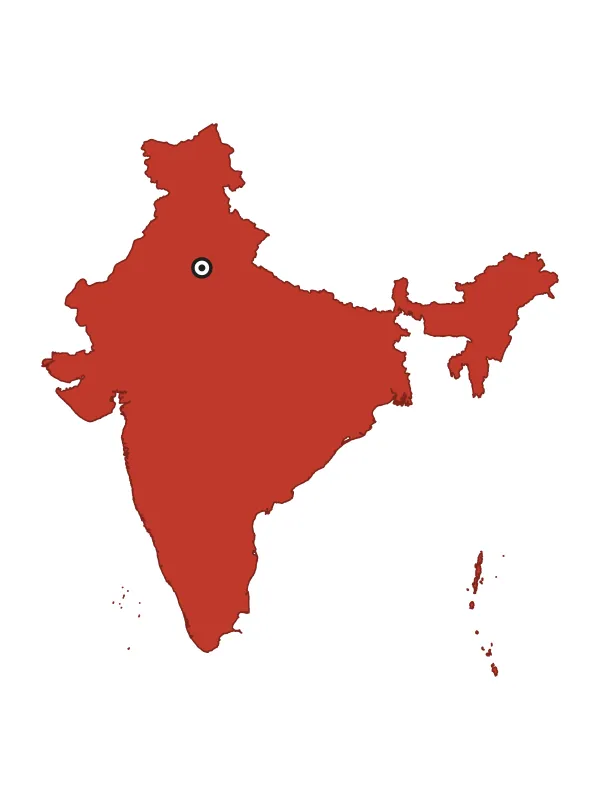
India: history in brief
One of the world's oldest civilisations, which gave humanity our numerals with zero, chess and yoga.
Test yourself
Which came first?
History in brief
Ancient world In the 3rd millennium BC the Indus Valley had cities with water supply and drains; traces remain in India at Lothal and Dholavira. The Vedas and the teaching of the Buddha arose here, and in the 3rd century BC King Ashoka united almost the whole subcontinent.
Middle Ages In 628 the mathematician Brahmagupta set out the rules for calculating with zero. The carved temples of Khajuraho and Konark were built, and around 1200 the Qutb Minar rose in Delhi.
Early modern & modern era The Mughal Empire, from 1526, built the Red Fort and the Taj Mahal. From the 17th century European companies traded in India, and in the 19th century it became part of the British Empire and got its railways.
Contemporary era On 15 August 1947 India became independent. India makes more films than any other country, the cricket team has won the World Cup more than once, and in 2023 Chandrayaan-3 became the first to land near the Moon's south pole.
Interesting facts
- The Iron Pillar of Delhi has stood for about 1,600 years and has barely rusted.
- In 1913 Rabindranath Tagore became the first non-European to win a Nobel Prize.
- India's first train ran from Bombay to Thane in 1853; today its railways are among the largest in the world.
- Emperor Shah Jahan built the Taj Mahal in memory of his beloved wife; it took about 20 years.
- From the 5th century thousands of students studied at the monastic university of Nalanda, one of the first of its kind in the world.
Key moments
- 322 BCChandragupta founds the Maurya EmpireIt was the first state to unite most of the Indian subcontinent; the date is approximate.
- 261 BCKalinga War and Ashoka's change of heartShocked by the war's toll, Emperor Ashoka gave up conquest and became a patron of Buddhism.
- 320Gupta Empire beginsThe Gupta era is called India's golden age, when science, mathematics and literature flourished.
- 1206Delhi Sultanate foundedQutb ud-Din Aibak, a former slave soldier, became the first Sultan of Delhi.
- 1498Vasco da Gama reaches India by seaThe Portuguese navigator sailed around Africa and became the first European to reach India by sea, at Calicut.
- 1632Construction of the Taj Mahal beginsEmperor Shah Jahan began building a mausoleum in Agra in memory of his beloved wife Mumtaz Mahal.
All dates (15)
Ancient world
- 322 BCChandragupta founds the Maurya EmpireIt was the first state to unite most of the Indian subcontinent; the date is approximate.
- 261 BCKalinga War and Ashoka's change of heartShocked by the war's toll, Emperor Ashoka gave up conquest and became a patron of Buddhism.
- 320Gupta Empire beginsThe Gupta era is called India's golden age, when science, mathematics and literature flourished.
Middle Ages
- 1206Delhi Sultanate foundedQutb ud-Din Aibak, a former slave soldier, became the first Sultan of Delhi.
- 1336Vijayanagara Empire foundedIts capital in southern India, Hampi, was one of the richest cities in the world; its ruins are a UNESCO site.
Early modern & modern era
- 1498Vasco da Gama reaches India by seaThe Portuguese navigator sailed around Africa and became the first European to reach India by sea, at Calicut.
- 1526First Battle of PanipatBabur defeated the Sultan of Delhi and founded the Mughal Empire.
- 1632Construction of the Taj Mahal beginsEmperor Shah Jahan began building a mausoleum in Agra in memory of his beloved wife Mumtaz Mahal.
- 1639Red Fort begun in DelhiPlanning to move his capital to Delhi, Shah Jahan began a palace-fortress of red sandstone there.
- 1853India's first passenger trainA 14-carriage train ran 34 km from Bombay to Thane, the start of one of the world's biggest railway networks.
- 1911Capital to move to DelhiAt the Delhi Durbar it was announced that the capital of British India would move from Calcutta to Delhi.
- 1913India's first feature filmDadasaheb Phalke screened the silent film Raja Harishchandra in Bombay, the birth of Indian cinema.
Contemporary era
- 1928Raman effect discoveredIn Calcutta, C. V. Raman found a new kind of light scattering, winning a Nobel Prize; 28 February is India's Science Day.
- 1951First Asian GamesAthletes from 11 countries gathered in New Delhi; the Games became Asia's biggest multi-sport event.
- 2023Chandrayaan-3 lands on the MoonIndia became the first country to land a spacecraft near the Moon's south pole.
5 questions of the day Where was it? Timeline
Eras
- Ancient worldbefore 476 · 178 events
- Middle Ages476–1491 · 206 events
- Early modern & modern era1492–1913 · 251 events
- Contemporary era1914 onwards · 217 events
History of countries
 Afghanistan
 Albania
 Algeria
 Andorra
 Angola
 Antigua and Barbuda
 Argentina
 Armenia
 Australia
 Austria
 Azerbaijan
 Bahamas
 Bahrain
 Bangladesh
 Barbados
 Belarus
 Belgium
 Belize
 Benin
 Bhutan
 Bolivia
 Bosnia and Herzegovina
 Botswana
 Brazil
 Brunei
 Bulgaria
 Burkina Faso
 Burundi
 Cambodia
 Cameroon
 Canada
 Cape Verde
 Central African Republic
 Chad
 Chile
 China
 Colombia
 Comoros
 Costa Rica
 Croatia
 Cuba
 Cyprus
 Czechia
 Denmark
 Djibouti
 Dominica
 Dominican Republic
 DR Congo
 East Timor
 Ecuador
 Egypt
 El Salvador
 Equatorial Guinea
 Eritrea
 Estonia
 Eswatini
 Ethiopia
 Fiji
 Finland
 France
 Gabon
 Gambia
 Georgia
 Germany
 Ghana
 Greece
 Grenada
 Guatemala
 Guinea
 Guinea-Bissau
 Guyana
 Haiti
 Honduras
 Hungary
 Iceland
 India
 Indonesia
 Iran
 Iraq
 Ireland
 Israel
 Italy
 Ivory Coast
 Jamaica
 Japan
 Jordan
 Kazakhstan
 Kenya
 Kiribati
 Kuwait
 Kyrgyzstan
 Laos
 Latvia
 Lebanon
 Lesotho
 Liberia
 Libya
 Liechtenstein
 Lithuania
 Luxembourg
 Madagascar
 Malawi
 Malaysia
 Maldives
 Mali
 Malta
 Marshall Islands
 Mauritania
 Mauritius
 Mexico
 Micronesia
 Moldova
 Monaco
 Mongolia
 Montenegro
 Morocco
 Mozambique
 Myanmar
 Namibia
 Nauru
 Nepal
 Netherlands
 New Zealand
 Nicaragua
 Niger
 Nigeria
 North Korea
 North Macedonia
 Norway
 Oman
 Pakistan
 Palau
 Palestine
 Panama
 Papua New Guinea
 Paraguay
 Peru
 Philippines
 Poland
 Portugal
 Qatar
 Republic of the Congo
 Romania
 Russia
 Rwanda
 Saint Kitts and Nevis
 Saint Lucia
 Saint Vincent and the Grenadines
 Samoa
 San Marino
 São Tomé and Príncipe
 Saudi Arabia
 Senegal
 Serbia
 Seychelles
 Sierra Leone
 Singapore
 Slovakia
 Slovenia
 Solomon Islands
 Somalia
 South Africa
 South Korea
 South Sudan
 Spain
 Sri Lanka
 Sudan
 Suriname
 Sweden
 Switzerland
 Syria
 Tajikistan
 Tanzania
 Thailand
 Togo
 Tonga
 Trinidad and Tobago
 Tunisia
 Turkey
 Turkmenistan
 Tuvalu
 Uganda
 Ukraine
 United Arab Emirates
 United Kingdom
 United States
 Uruguay
 Uzbekistan
 Vanuatu
 Vatican City
 Venezuela
 Vietnam
 Yemen
 Zambia
 Zimbabwe
Spotted a mistake or a disputed fact? Write to us and we will check and fix it: [email protected]